








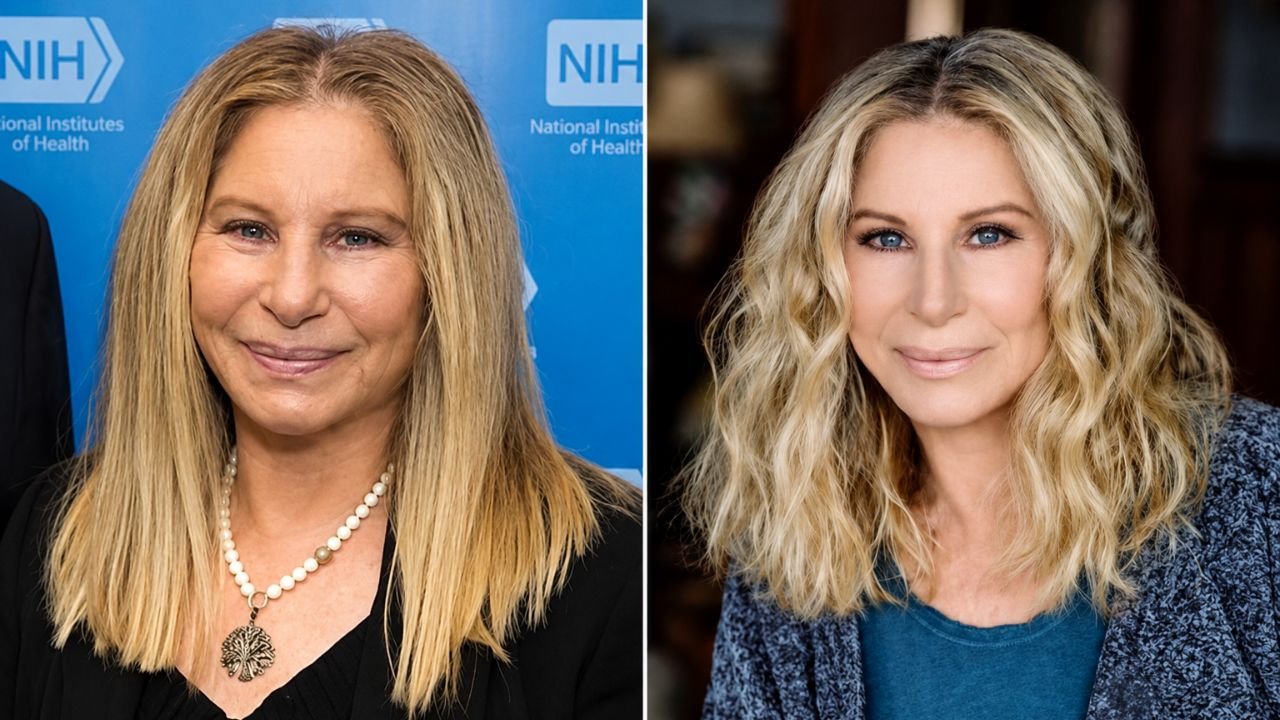
Barbra Streisand has spent more than six decades moving between music, Broadway, film, television, writing, and directing without settling into only one identity. Born Barbara Joan Streisand in Brooklyn, New York, on April 24, 1942, she grew from a teenager fascinated by acting into one of the most recognized performers in American entertainment. Her career includes major records, acclaimed films, Broadway performances, directing credits, songwriting achievements, and some remarkable chart records. What makes her story especially interesting is that she did not begin with the advantages usually associated with Hollywood success, and she spent much of her career insisting on having control over the work she created.
| Detail | Information |
|---|---|
| Full Name | Barbara Joan Streisand |
| Known As | Barbra Streisand |
| Born | April 24, 1942 |
| Birthplace | Brooklyn, New York, USA |
| Profession | Singer, Actress, Director, Producer, Writer |
| Broadway Breakthrough | Funny Girl |
| Film Debut | Funny Girl (1968) |
| Major Film | A Star Is Born (1976) |
| Directorial Debut | Yentl (1983) |
| Spouse | James Brolin |
| Son | Jason Gould |
| Major Music Record | No. 1 albums across six decades |
| Notable Songs | The Way We Were, Evergreen, Woman in Love, People |
| Major Honors | Academy Awards, Grammy Awards, Emmy Awards, Golden Globes, Kennedy Center Honor |
| Known For | Music, Broadway, film, directing, and creative control |
Barbra Streisand’s Early Life in Brooklyn
Barbra Streisand was born into a Brooklyn family and experienced the loss of her father, Emanuel Streisand, when she was still very young. Her mother, Diana, worked to support the family, and Streisand later described her childhood as modest and sometimes difficult. She developed an interest in performing while she was still a teenager, particularly after seeing The Diary of Anne Frank and becoming fascinated by the possibility of acting on stage. Rather than following a conventional path into higher education, she focused increasingly on finding a way into show business.
Streisand graduated from Erasmus Hall High School in 1959 when she was only 16. The school had an unusual connection to her future because another future music star, Neil Diamond, was also a student there. Streisand sang in the school’s Freshman Chorus and Choral Club, although there was little reason at the time to assume that she would become one of the best-known recording artists in the world. Her early ambitions were centered more on acting than on becoming a professional singer. That distinction helps explain why her later career developed across several entertainment fields rather than following a simple path from singing to recording success.
After leaving high school, Streisand moved toward Manhattan and began trying to find acting work. She was young, inexperienced, and had little money, but she was determined to get into the theater business. During this period she sometimes stayed with friends and carried her belongings with her as she pursued opportunities. She did not have the kind of polished celebrity image that studios often expected from young performers, and early rejection became part of her experience. Instead of allowing those setbacks to end her ambitions, she began looking for other ways to get in front of an audience.
How Barbra Streisand Began Her Career
Singing eventually became Streisand’s doorway into professional entertainment. She entered a talent contest at a Greenwich Village club called the Lion and won, giving her an early indication that audiences responded strongly to her voice. In 1960 she began performing professionally at the Bon Soir nightclub in Greenwich Village, where she opened for comedian Phyllis Diller. The nightclub environment allowed her to develop a distinctive stage personality while she continued to pursue her original goal of becoming an actress. Her performances soon began attracting attention beyond the small clubs where she had started.
Streisand’s appearance also became part of the story of her rise. Hollywood had long favored a narrow image of what a leading woman was supposed to look like, and she was told by people in the entertainment business that she did not fit that image. Suggestions that she change her appearance, including pressure to alter her nose, were not unusual in an industry that placed heavy emphasis on conventional beauty. Streisand refused to remake herself simply to satisfy those expectations. Her eventual success made that refusal significant because she became a major star without abandoning the features that others had treated as weaknesses.
Her stage presence became increasingly important as she moved from nightclubs into theater. She was not simply a technically strong singer; she could build a character through the way she delivered a song. That quality helped her make the transition from cabaret performances to Broadway, where an audience expected both acting and singing. Her early experience also taught her how to command a room with little more than a microphone and a piano. Those skills became essential when she later began appearing on television and recording albums.
Barbra Streisand’s Broadway Breakthrough
Streisand’s first major Broadway role came in I Can Get It for You Wholesale in 1962. The production gave her a larger professional platform and introduced her to audiences who might never have seen her at a Greenwich Village nightclub. Her performance attracted attention and helped establish her as a distinctive new stage performer. Broadway also gave her the credibility needed to move beyond the nightclub circuit and into television and recording.
Her defining Broadway breakthrough came with Funny Girl, in which she played Fanny Brice. The role suited her because it required humor, dramatic timing, personality, and a powerful singing voice. Streisand’s performance became closely associated with the character, and when the musical was adapted into a movie, she carried the role with her to Hollywood. The stage success of Funny Girl therefore became the bridge between her early theater career and her emergence as a major film star.
The Funny Girl period also established something that would become a pattern throughout Streisand’s career. She was most effective when she could combine singing with acting instead of treating them as separate skills. Her ability to make a song feel like part of a character’s story became one of the reasons her recordings remained closely connected to Broadway, traditional pop, film music, and theatrical material. This approach set her apart from many pop performers who were emerging during the same period.
The Recording Career That Made Her a Music Star
Columbia Records signed Streisand early in the 1960s, and the agreement gave her an unusual degree of creative control. She accepted lower pay in exchange for retaining control over her performances, a decision that would become important to the way she managed her career. Her first studio album, The Barbra Streisand Album, arrived in 1963 and won the Grammy Award for Album of the Year. A debut album receiving that level of recognition immediately established her as more than a promising Broadway performer.
Her early albums came quickly and helped build an audience that extended beyond theater fans. The Second Barbra Streisand Album and The Third Album followed in 1963 and 1964, while People became another major success in 1964. My Name Is Barbra followed in 1965 and showed how closely her recordings could be connected to her stage personality. Instead of chasing every musical trend, Streisand developed a style built around interpretation, phrasing, dramatic delivery, and carefully selected material.
Some of the defining characteristics of her recording career include:
- Broadway and show-tune interpretations
- Traditional pop and vocal standards
- Film songs and original material
- Collaborations with major singers and musicians
- Concept albums built around particular themes
- Songs that combined theatrical storytelling with mainstream pop
This flexibility allowed Streisand to remain commercially relevant as musical fashions changed. Rock, disco, adult contemporary pop, and contemporary vocal music all became major parts of the American music market during her career, yet she continued to build an audience without abandoning the qualities that made her recognizable. Her voice remained the central feature, but the material around it changed with the times. That ability to adapt without losing her identity became one of the strongest features of her career.
Barbra Streisand’s Billboard Records
Streisand’s career on the Billboard charts is one of the clearest measures of her longevity. She became the first woman to earn 11 No. 1 albums on the Billboard 200, a record that reflected not only her popularity but also the consistency of her audience across several decades. She is also known for becoming the only artist to reach No. 1 on the Billboard 200 in six different decades. Those records are particularly striking because her career began before many of the technologies and musical formats that later transformed the recording industry.
Her success was not limited to albums. Streisand also achieved five No. 1 singles on the Billboard Hot 100, including several songs that became closely identified with her career. These included The Way We Were, Evergreen, You Don’t Bring Me Flowers, No More Tears (Enough Is Enough), and Woman in Love. Each represented a different period of her musical career, which shows how long her ability to reach mainstream audiences lasted. Rather than having one short peak, she repeatedly returned to the top of the charts.
The Billboard achievements are especially useful when looking at Barbra Streisand as a recording artist rather than simply a famous actress. Many performers become known for a handful of songs and then gradually disappear from the commercial charts. Streisand repeatedly released successful albums while also acting in films, appearing on television, and taking on other creative responsibilities. Her music career therefore remained a central part of her public identity even when her attention shifted toward filmmaking.
Barbra Streisand and the Rise of the Singer-Actress
The 1960s made Streisand unusual because she could move comfortably between records, television, Broadway, and movies. Her television appearances introduced her personality to a national audience while her albums gave listeners a way to experience her performances outside the theater. She also developed a reputation for taking songs that could have been simple vocal performances and turning them into dramatic moments. That ability helped her build a career in which acting and singing constantly reinforced one another.
Her television work also included a memorable appearance with Judy Garland. Streisand performed alongside Garland during The Judy Garland Show, giving viewers a meeting between an established entertainment legend and a young performer who was rapidly becoming a star herself. The appearance was significant because Garland was already an icon of American musical entertainment. Streisand’s ability to share the stage with her demonstrated how quickly the young performer had moved from nightclub singer to national celebrity.
Funny Girl Took Barbra Streisand to Hollywood
The 1968 film version of Funny Girl was one of the most important moments in Streisand’s career. She reprised her Broadway role as Fanny Brice and brought the character’s humor, vulnerability, ambition, and musical ability to the screen. The performance earned her the Academy Award for Best Actress, placing her among the most celebrated new film performers of the era. The movie also established that her unusual combination of acting and singing could work just as powerfully in cinema as it had on stage.
Funny Girl did more than make Streisand a movie star. It created a template for the kind of film projects she would choose later in her career. She was rarely interested in being simply the attractive lead in a conventional Hollywood production. Her strongest projects gave her a character with a distinct personality and room to perform musically. That preference helped shape her decisions as she gained more control over her work.
Her film career continued with movies such as Hello, Dolly!, What’s Up, Doc?, The Way We Were, A Star Is Born, Nuts, Yentl, The Prince of Tides, The Mirror Has Two Faces, Meet the Fockers, and Little Fockers. Some of these films were commercial successes, while others became better known for their performances, direction, or cultural impact. Taken together, they show how widely Streisand’s interests extended beyond the traditional musical.
Barbra Streisand and The Way We Were
The Way We Were became one of the defining films of Streisand’s acting career. Released in 1973, the movie paired her with Robert Redford and told the story of two people whose political beliefs, personalities, and ambitions pull them together and apart over time. Streisand’s performance as Katie Morosky gave her a character who was passionate, outspoken, and politically engaged rather than simply conventionally romantic. The movie’s title song also became one of the most recognizable recordings associated with her career.
The relationship between Streisand and Redford continued to be remembered long after the film’s release. Decades later, their connection to The Way We Were remained part of public interest in Streisand’s career. The song itself has also endured as one of her signature recordings, showing how successfully her film work and music career could reinforce one another.
Barbra Streisand and A Star Is Born
In 1976, Streisand starred in A Star Is Born alongside Kris Kristofferson. The film gave her another major musical role while also allowing her to participate in the creation of music connected to the story. Evergreen, the love theme associated with the movie, became one of her best-known songs and earned the Academy Award for Best Original Song.
The achievement was significant because Streisand was not simply receiving recognition for acting in a musical film. She had become an important creative force behind the music itself. Evergreen demonstrated how her interests as a singer, actress, and songwriter could overlap in one project. The success of A Star Is Born helped strengthen the idea that Streisand could control multiple aspects of a production rather than simply perform material created by others.
The Hit Song Barbra Streisand Turned Down
One of the most unusual stories connected to Barbra Streisand involves a song she never recorded. In the early 1970s, producer Tom Catalano prepared an instrumental version of Delta Dawn with Streisand in mind as the vocalist. Streisand disliked the song and turned it down, leaving Catalano with a prepared backing track but no singer for the project. The opportunity then moved to Helen Reddy, whose version became a major pop hit.
Reddy’s recording of Delta Dawn eventually reached No. 1 on the Billboard Hot 100 in September 1973. The story is interesting because Streisand had already established herself as a major recording artist, while Reddy was still building her career in American pop music. One artist’s rejection became another artist’s breakthrough. It is a useful reminder that even performers with extraordinary careers cannot know in advance which songs will become hits.
The Delta Dawn story also says something about Streisand’s approach to material. She has always been selective about songs and projects, and her catalog reflects a strong preference for material that fits her voice and dramatic instincts. Turning down a future No. 1 does not mean she made a mistake; it shows that a song can be perfect for one performer and wrong for another. Reddy’s recording ultimately gave Delta Dawn the emotional and vocal identity that audiences came to associate with it.
Barbra Streisand and Stevie Wonder
Streisand’s career includes collaborations with some of the most respected musicians of several generations, including Stevie Wonder. The two artists recorded People together for Streisand’s 2014 album Partners. The collaboration brought together two distinctive voices from different musical traditions and connected one of Streisand’s best-known songs with Wonder’s style.
Their connection goes back further than the studio recording. Streisand and Wonder had also shared a live musical moment years earlier, making the later recording feel like the continuation of a relationship between two established performers rather than a random celebrity pairing. The Partners album itself was built around Streisand singing with other major male artists, and the Stevie Wonder collaboration became one of its notable pairings.
Barbra Streisand and The Beatles
Streisand’s musical history also overlaps with The Beatles in an interesting way. She recorded material associated with the group and with the wider British songwriting movement that changed popular music during the 1960s. Her approach was different from the Beatles’ rock-oriented sound, but she was working within the same rapidly changing musical culture.
Her recordings of Beatles-related material demonstrate how she could reinterpret contemporary songs through a traditional pop and theatrical vocal style. Instead of copying the original approach, she could reshape material around her own phrasing and dramatic instincts. This is part of the reason her catalog has remained interesting to listeners who may not normally listen to traditional pop.
The connection later became even more direct through Paul McCartney. McCartney eventually appeared on Streisand’s later work, linking her career not only to the Beatles’ songwriting legacy but also to one of the group’s surviving members. This makes the relationship between Barbra Streisand and The Beatles more than a simple matter of having recorded similar-era music.
Barbra Streisand’s Directing Career
One of the most important parts of Streisand’s career is her work behind the camera. She did not stop after becoming a successful actress and singer; she wanted greater control over the stories she brought to the screen. That ambition led to Yentl, a project that she developed, produced, directed, and starred in. The film became a major milestone in Hollywood history because it placed a woman in several powerful creative positions on a major studio production.
Yentl was released in 1983 and was based on Isaac Bashevis Singer’s story about a Jewish woman who disguises herself as a man to pursue education. Streisand’s involvement extended far beyond acting, and the project allowed her to combine her interest in performance with her desire to shape the entire production. Her work earned her the Golden Globe for Best Director, making her the first woman to win that award.
Her directing career continued with The Prince of Tides in 1991 and The Mirror Has Two Faces in 1996. These films showed that directing was not a one-time experiment for her. She was willing to take on the responsibilities of developing a story, working with actors, managing production, and shaping the final tone of a film.
Why Yentl Was So Important to Her Career
Yentl deserves special attention because it changed how audiences could understand Streisand’s role in Hollywood. Before the film, she was already one of the most famous singers and actresses in the United States. With Yentl, she demonstrated that she wanted authority over the creative process rather than simply accepting roles written and directed by other people.
The film also connected directly with themes that had interested Streisand throughout her career. Its story centered on a woman challenging the restrictions placed on her and pursuing education despite those limitations. The project therefore combined performance with a story that reflected questions about gender, identity, ambition, and independence.
Barbra Streisand’s Most Important Achievements
Streisand’s awards and honors cover music, acting, television, filmmaking, and cultural contribution. She has received major recognition from the Academy Awards, Grammy Awards, Emmy Awards, Golden Globes, and other institutions. Her career has also been recognized with major lifetime honors, including the Kennedy Center Honor and the Presidential Medal of Freedom. Her achievement across entertainment fields is one reason she is frequently described as one of the most accomplished American performers.
Some of the major highlights of her career include:
- Academy Awards for acting and songwriting
- Grammy Awards, including Album of the Year
- Emmy Awards for television work
- Golden Globe recognition for acting, music, and directing
- Kennedy Center Honor
- Presidential Medal of Freedom
- American Film Institute recognition
- Major Billboard chart records
- Successful Broadway performances
- Acclaimed directing work
Her awards matter, but the length of her career may be even more impressive. Streisand entered professional entertainment in the early 1960s and continued working across several fields for decades. Few performers have maintained that level of recognition while repeatedly changing their role within the entertainment industry.
Barbra Streisand’s Personal Life and Family
Streisand’s personal life has received considerable attention because her career has been so public. She was married to actor Elliott Gould from 1963 until their divorce in 1971, and they have a son, Jason Gould. She later had high-profile relationships before marrying actor James Brolin in 1998. The marriage to Brolin has remained one of the longest and most stable relationships associated with her adult life.
Her family has occasionally appeared in connection with her professional world, but Streisand has also maintained a strong boundary between her public career and private life. Her son Jason Gould became an actor and singer in his own right, giving the family another connection to entertainment. Streisand’s relationship with her family has sometimes appeared in interviews and public appearances, but she has generally been more interested in discussing her work than providing constant details about her private life.
Barbra Streisand’s Life Away From the Stage
Streisand has also developed interests outside music and film. Design, photography, politics, philanthropy, and social causes have all played roles in her public life. Her philanthropic work has supported causes involving health, environmental issues, women’s rights, civil rights, and other areas that she has publicly supported over the years.
Her interest in women’s heart health became particularly notable through the establishment of the Barbra Streisand Women’s Heart Center. She has also supported research and advocacy connected with cardiovascular health. These activities show another side of her career that is often overlooked when discussions focus only on her songs and movies.
The Barbra Streisand Foundation and Philanthropy
Streisand established the Streisand Foundation in 1986, using it to support causes that have been important to her. Her philanthropic interests have included environmental protection, civil rights, women’s issues, voter education, and health. Rather than treating charity as a small side activity, she has used her public profile to bring attention to issues she considers important.
Her philanthropic work has also expanded into educational and research-related projects. The Barbra Streisand Institute at UCLA was established to encourage discussion and research around social issues and possible solutions. This work reflects her long-standing interest in using public influence beyond entertainment.
Barbra Streisand as an Author
Streisand added another major role to her career with her memoir My Name Is Barbra. Published in 2023, the book gave readers a detailed account of her childhood, career, relationships, performances, and experiences in the entertainment industry. The memoir was notable because much of the story came directly from Streisand rather than being reconstructed through interviews with journalists or biographies written by others.
The book also provides context for decisions that shaped her career. Her early struggles, her relationship with theater, her recording work, her film projects, and her experiences with Hollywood all become part of a larger personal narrative. For readers interested in Barbra Streisand biography, the memoir is particularly valuable because it gives her own perspective on events that have been discussed publicly for decades.
Barbra Streisand’s Influence on Female Performers
Streisand’s influence extends beyond the records and movies she made herself. She became successful in an era when women in entertainment were often expected to fit narrow roles, particularly in film. Instead, she demanded more control over her work and eventually moved into producing and directing.
Her career demonstrated that a woman could be the central creative force behind a major entertainment project. She could perform the leading role, sing the music, help shape the production, and direct the film. That model became meaningful to later female performers who wanted to participate in the business side of entertainment rather than remain only in front of the camera.
The Meaning of the Streisand Effect
The term “Streisand effect” has become part of popular language, although it is not directly about her music or acting. It describes a situation in which an attempt to hide or suppress information ends up attracting more attention to it. The phrase came from a legal dispute involving photographs of Streisand’s Malibu home, after which public interest in the images increased dramatically.
The term is now used far beyond celebrity culture and can appear in discussions about privacy, the internet, journalism, and social media. It is an unusual example of a celebrity’s name becoming attached to a broader concept in public discussion. Even people who know little about Streisand’s music may have encountered the phrase.
What Makes Barbra Streisand’s Career Different
The simplest way to describe Streisand’s career is to say that she succeeded in several industries at once. She was a Broadway performer, recording artist, movie star, songwriter, producer, director, author, and philanthropist. Yet the more interesting point is that she repeatedly used success in one area to create opportunities in another.
Her singing career helped establish her film career, while her film success gave her greater power in music and production. Her Broadway experience strengthened her acting, and her acting career gave her opportunities to create films such as Yentl. Each stage of her career created leverage for the next one.
Her insistence on artistic control is another major part of the story. From her Columbia Records contract to her work as a filmmaker, she consistently sought a say in how her performances and projects were presented. That approach sometimes made her demanding to work with, but it also allowed her to build a career that reflected her own preferences instead of following a standard Hollywood formula.
Barbra Streisand’s Legacy in Music and Film
Streisand’s legacy cannot be reduced to one song, one movie, or one award. Her catalog includes Broadway recordings, pop albums, film soundtracks, collaborations, standards, original songs, and later recordings that connected her with younger generations of listeners. Her movies similarly range from musicals and romantic dramas to comedies and projects in which she took on directing responsibilities.
Her Billboard history provides one measure of her longevity, while her awards provide another. The more revealing measure may be the number of different entertainment fields in which she remained relevant. Very few artists can point to a career that includes Broadway success, Grammy-winning albums, Oscar-winning performances, directing achievements, major chart records, and decades of public interest.
Barbra Streisand’s Career in Perspective
Looking at Streisand’s life as a whole shows that her success did not come from a single breakthrough. It developed through a series of decisions that gradually expanded her opportunities. She started in small clubs, moved into Broadway, built a recording career, entered Hollywood, and then pushed into producing and directing.
Her story also contains plenty of choices that could easily have gone differently. She rejected songs that later became hits, refused to change her appearance to satisfy critics, and took creative risks that were not guaranteed to succeed. Those choices helped create a career that feels distinctly personal rather than manufactured.
Today, Barbra Streisand remains one of the defining American entertainment figures of the last six decades. Her name is connected with Broadway, Hollywood, popular music, directing, philanthropy, and several generations of performers. The lasting appeal of her career comes from the fact that she was never limited to one profession or one period of popularity.
Frequently Asked Questions About Barbra Streisand
1. How old is Barbra Streisand?
Barbra Streisand was born on April 24, 1942, in New York City. Her professional career began in the early 1960s, meaning she has been active in entertainment for more than six decades. Her work has covered music, Broadway, television, film, directing, writing, and philanthropy.
2. What is Barbra Streisand best known for?
Barbra Streisand is best known as a singer and actress, but her career extends far beyond those two roles. She became famous through Broadway and recording, won an Academy Award for Funny Girl, starred in A Star Is Born, directed Yentl, and achieved major Billboard success. Her ability to work successfully across several entertainment fields is a defining part of her reputation.
3. How many Oscars has Barbra Streisand won?
Barbra Streisand has won two Academy Awards. She won Best Actress for Funny Girl and later received the Academy Award for Best Original Song for Evergreen from A Star Is Born. These wins reflect two different sides of her career, acting and music.
4. Who is Barbra Streisand married to?
Barbra Streisand has been married to actor James Brolin since 1998. Before Brolin, she was married to actor Elliott Gould, with whom she has a son, Jason Gould. Her marriage to Brolin has remained one of the longest relationships of her public life.
5. What song did Barbra Streisand turn down that became a No. 1 hit?
Barbra Streisand turned down Delta Dawn after producer Tom Catalano prepared an instrumental track with her in mind. Helen Reddy subsequently recorded the song, and her version reached No. 1 on the Billboard Hot 100 in 1973. The story remains one of the more surprising examples of a hit song that passed through the hands of a major star before finding its final voice.
Conclusion
Barbra Streisand’s career is remarkable because it was never confined to one stage of entertainment. She began as a young performer trying to find work in New York, became a Broadway star, built one of the most successful recording careers in American music, moved into Hollywood, and eventually took control behind the camera as a director and producer. Her chart records, awards, famous performances, and long list of films tell only part of the story. The more revealing part is how often she pushed beyond the role that audiences already knew her for.
Her career also shows the value of making creative choices based on personal conviction. She refused pressure to change her appearance, negotiated for artistic control, rejected material that did not suit her, and took on projects that gave her greater authority over the final result. Some choices became major successes, while others simply became interesting parts of her history. That combination of talent, independence, and longevity is why Barbra Streisand remains an important figure in music, film, theater, and American popular culture.
If you enjoyed learning about Barbra Streisand’s life, career, music, movies, and achievements, explore more inspiring stories and profiles in our Celebrity section.