





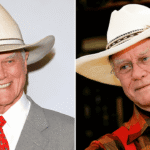

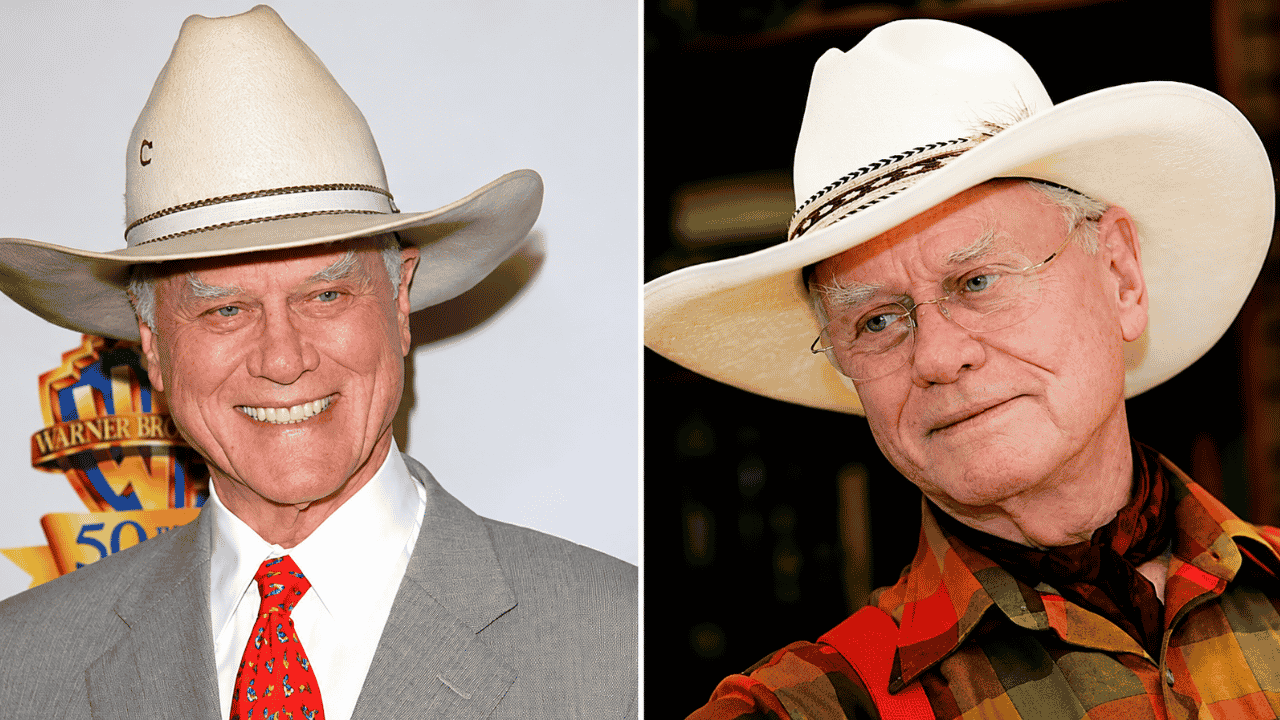
Larry Hagman became one of American television’s most recognizable actors through two very different characters. He first became widely known as Major Anthony Nelson, the astronaut at the center of I Dream of Jeannie, before creating the far more ruthless J.R. Ewing on Dallas. The second role turned him into an international television star and helped make Dallas one of the most successful American dramas of its era. Behind those famous characters was a career that included theater, film, directing, producing, military service, philanthropy and a long marriage to Maj Axelsson.
Larry Hagman’s Early Life and Family
Larry Martin Hagman was born on September 21, 1931, in Fort Worth, Texas. His mother was Mary Martin, a performer who would later become one of Broadway’s best-known stars, while his father, Benjamin Jackson Hagman, was an attorney in Parker County. His parents divorced when Larry was five, and much of his childhood was spent under the care of his maternal grandmother, Juanita Martin. His early years moved between Texas and California and gave him a childhood that was far less settled than the glamorous Hollywood career he would eventually build.
Mary Martin’s career had a major influence on her son, but Larry Hagman did not simply follow her path. His father encouraged him to take part in traditional Texas activities such as football, boxing, hunting and shooting, while his mother exposed him to the performing world. Hagman later studied drama and dance at Bard College in New York, although he left before completing his studies. He also gained practical experience with the regional theater organization associated with director Margo Jones in Dallas.
His Mother Mary Martin
Mary Martin’s success gave Hagman an unusual introduction to professional entertainment. She became famous for major Broadway productions including South Pacific and Peter Pan, and her career eventually took her around the United States and abroad. Larry joined the London production of South Pacific in the early 1950s, giving him an opportunity to work professionally before he had established himself as a leading actor. His later Television Academy interview also shows how much he remembered about his childhood and his relationship with his mother.
Hagman was aware that being Mary Martin’s son opened doors, but he also understood that an opportunity was not the same as a successful career. He later acknowledged that his family connection helped him get started, while emphasizing that he still had to prove himself once he entered the profession. His career eventually moved far beyond the shadow of his mother because his own performances became the reason audiences knew his name.
Larry Hagman’s Early Career
Hagman’s professional career developed through theater before television made him famous. He appeared in stage productions in London and New York and worked in live television during the period when many programs were broadcast directly rather than filmed. In 1961, he received a continuing role on the daytime drama The Edge of Night, which gave him regular television experience and helped him develop his screen technique. He later described the soap opera experience as an especially valuable opportunity for an actor.
His early film work followed soon afterward. He appeared in Fail-Safe, Ensign Pulver, In Harm’s Way and The Group during the 1960s, working with established filmmakers and actors before he received his first major television starring role. These projects showed that Hagman was capable of handling serious dramatic material as well as comedy. His early career therefore included a much wider selection of work than the two television characters for which he became famous.
Military Service in the United States Air Force
Before becoming a major television star, Hagman spent four years serving with the U.S. Air Force. His military service took place largely in Europe, where he used his entertainment skills to produce and direct shows for service members at American Air Force bases. This experience gave him early exposure to directing and production, skills that later became an important part of his professional career. His time in the military also introduced him to Maj Axelsson, a Swedish clothing designer whom he would later marry.
His military years were therefore more than a pause between acting jobs. Hagman was already learning how to organize productions, work with performers and manage an audience before Hollywood made him a household name. Those skills became useful when he eventually began directing television episodes himself. His later work behind the camera can be traced partly to this early experience in military entertainment.
Larry Hagman and Maj Axelsson
Larry Hagman married Maj Irene Axelsson on September 21, 1954. She was Swedish and worked as a clothing designer when the two met during Hagman’s time in London. Their marriage lasted for 58 years, making Maj an important part of Hagman’s personal life even though she remained largely outside the public spotlight created by his television career. They had two children, Heidi Kristina Mary and Preston Benjamin Axel.
Maj also became an important source of support during some of the biggest decisions of Hagman’s career. When Dallas was being developed, Hagman was not immediately convinced that playing J.R. Ewing would be a worthwhile move. His wife encouraged him to take the opportunity, and the role eventually became the defining performance of his career. Their long marriage continued through the enormous success of Dallas, Hagman’s health problems and his later return to television.
Larry Hagman in I Dream of Jeannie
Hagman’s first major television breakthrough came with I Dream of Jeannie. NBC premiered the sitcom in 1965, with Hagman playing Major Anthony Nelson and Barbara Eden playing Jeannie, a genie who becomes connected to the astronaut after he discovers her. The series combined romantic comedy, fantasy and workplace situations and quickly became one of Hagman’s best-known projects. It ran for five seasons and produced 139 episodes before ending in 1970.
Major Tony Nelson was very different from J.R. Ewing. Tony was usually the straight man who reacted to Jeannie’s magical behavior, while Hagman’s performance relied heavily on timing and his increasingly frustrated reactions to situations he could not control. His chemistry with Barbara Eden became one of the show’s central attractions. Hagman’s own Television Academy interview includes extensive discussion of Eden, the production of the series, Sidney Sheldon and the show’s unusual standards and special-effects requirements.
Larry Hagman and Barbara Eden
Hagman and Barbara Eden became closely associated with I Dream of Jeannie, but their working relationship extended beyond the original sitcom. Eden later appeared with Hagman again in Dallas, creating a memorable reunion between two actors who had already spent years associated with television history. The Television Academy’s interview archive contains separate material about Eden working with Hagman on I Dream of Jeannie and later reuniting with him on Dallas.
The success of I Dream of Jeannie gave Hagman a stable television identity, but he did not remain confined to comedy. After the series ended, he continued taking television and film roles and explored different genres. His work during the 1970s included projects such as The Good Life, Streets of San Francisco, McCloud, Superman and S.O.B. Those roles helped bridge the gap between Major Tony Nelson and the character who would transform his career.
How Larry Hagman Became J.R. Ewing
In 1977, Hagman returned to Texas for a new television project called Dallas. He was cast as John Ross “J.R.” Ewing, the ambitious and morally questionable older son of oil businessman Jock Ewing. Dallas initially began as a five-part miniseries before CBS expanded it into a weekly series. The program eventually became an international phenomenon and remained on television for more than a decade.
J.R. was not initially intended to overshadow every other character. Hagman’s performance changed the balance of the show because audiences became fascinated by the character’s schemes, ambition and willingness to manipulate the people around him. The Texas State Historical Association notes that J.R. eventually became the pivotal character and the only character to appear in all 356 episodes of the original series.
The Real-Life Inspiration Behind J.R. Ewing
Hagman drew part of J.R.’s personality from a real Texas man named Jess Hall Jr., who had supervised him during a summer job. The connection helped him create a character who felt distinctly Texan rather than like a generic television villain. J.R.’s confidence, sharp humor and ability to use other people became central elements of Hagman’s performance. That combination helped make the character recognizable even outside the United States.
Dallas eventually aired in more than 90 countries, turning J.R. Ewing into an international pop-culture figure. Hagman later described Dallas as the biggest achievement of his career in his Television Academy interview. The scale of the show’s success also gave him considerable influence over his own career and compensation.
Who Shot J.R.?
One of the most famous television cliffhangers in history came at the end of Dallas’s third season. J.R. was shot by an unknown attacker, leaving viewers with no immediate answer about whether the character would survive or who had pulled the trigger. The mystery generated months of speculation, and even bookmakers became involved by offering odds on possible suspects.
The answer was finally revealed in November 1980, when viewers learned that J.R.’s sister-in-law and mistress, Kristin Shepard, had shot him. The reveal attracted approximately 83 million viewers in the United States and an estimated 350 million worldwide, according to the Texas State Historical Association. At the time, it became the highest-rated episode of an American television series.
The storyline also changed Hagman’s bargaining position. During the months when audiences were waiting to learn J.R.’s fate, Hagman renegotiated his contract and became one of television’s highest-paid actors. The situation demonstrated how completely the character had moved from being one part of an ensemble to becoming the commercial center of the series.
Larry Hagman’s Work as a Director and Producer
Acting was only one part of Hagman’s career. He directed the 1972 film Beware! The Blob, a sequel to the original The Blob, and later directed television episodes. His work behind the camera became especially significant during Dallas, where he directed 32 episodes. He also directed three episodes of I Dream of Jeannie and seven episodes of In the Heat of the Night.
Hagman’s directing background allowed him to understand television from the production side as well as from the perspective of an actor. His Television Academy interview includes discussions of directing Dallas and becoming an executive producer. He also worked with Carroll O’Connor on In the Heat of the Night, building on a friendship that had begun years earlier during Hagman’s stage career.
Some notable parts of his work beyond acting include:
- Directing Beware! The Blob
- Directing 32 episodes of Dallas
- Directing three episodes of I Dream of Jeannie
- Directing seven episodes of In the Heat of the Night
- Serving as an executive producer on Dallas
- Appearing in television movies and feature films
- Returning to the J.R. Ewing role in the 2012 Dallas revival
Larry Hagman’s Movies and Television Career
Although Dallas dominated his later reputation, Hagman worked steadily in film and television throughout his career. His movie credits included Fail-Safe, Ensign Pulver, In Harm’s Way and The Group during the 1960s, followed by later appearances in films such as Superman and S.O.B. He also continued taking television roles after I Dream of Jeannie ended. His long filmography demonstrates that he was a working actor for decades rather than someone whose career depended on one successful sitcom.
His television work outside his two signature series included The Edge of Night, The Good Life, Streets of San Francisco, McCloud and Knots Landing. He also appeared in Dallas reunion productions after the original series ended. These projects allowed him to maintain his connection with audiences while experimenting with characters other than Tony Nelson and J.R. Ewing. His career therefore covered comedy, drama, television movies, feature films and directing.
Larry Hagman Net Worth and Career Success
There is no reliable public financial record that establishes an exact figure for Larry Hagman’s net worth when he died. His wealth was clearly substantial because of the enormous success of Dallas and the contract negotiations that followed the “Who Shot J.R.?” phenomenon. The Texas State Historical Association describes him as becoming one of the wealthiest actors in television as J.R. grew into the show’s central character.
Online estimates of Larry Hagman’s net worth differ considerably, so they should not be presented as verified figures. A more useful way to understand his financial success is to look at his career position during Dallas, when he became one of television’s highest-paid actors. His income also reflected his work as an actor, director, producer and television personality. Treating an internet estimate as an exact fact would give readers more certainty than the available evidence supports.
Larry Hagman’s Health Problems
Hagman’s health history became increasingly important during the later decades of his life. He developed smoking and drinking habits during his youth, but a health scare while filming The Cavern in Italy prompted him to quit smoking. He subsequently became an outspoken anti-smoking campaigner and chaired the American Cancer Society’s Great American Smokeout from 1981 to 1992. His public work on smoking prevention became an important part of his life away from acting.
Hagman continued to struggle with the consequences of heavy drinking. He was diagnosed with cirrhosis in 1992 and liver cancer in 1995, eventually receiving a liver transplant. The transplant allowed him to return to professional work, and he later became an advocate for organ donation and transplantation. His experiences with serious illness changed the focus of some of his public activities without ending his interest in acting.
His Interest in Renewable Energy
Later in life, Hagman also became known for his interest in renewable energy. He and Maj moved from Malibu to an Ojai ranch they called Heaven, where their home used a large residential solar-electric system. Hagman became an advocate for green energy and served as a spokesperson for SolarWorld in 2010. This part of his life is easy to overlook because it had little connection with the television characters that made him famous.
Larry Hagman Cause of Death
Larry Hagman cause of death was complications from acute myeloid leukemia. He died on November 23, 2012, at Medical City Dallas Hospital in Dallas, Texas, at the age of 81. The Television Academy describes his death as cancer-related, while the Texas State Historical Association provides the more specific diagnosis of acute myeloid leukemia. His final illness followed several years of serious health problems.
Hagman had been diagnosed with throat cancer in 2011 and received treatment while continuing to work. In 2012, he was diagnosed with preleukemia, which progressed to acute myeloid leukemia. Despite his illness, he returned to television for the new Dallas series and completed episodes for its second season before his death. His decision to continue working became one of the defining details of his final professional years.
When Did Larry Hagman Die?
Larry Hagman died on November 23, 2012, in Dallas, Texas. He was 81 years old and was surrounded by family and friends during his final period. His death occurred while the renewed Dallas series was still in production, meaning that his final television work was connected to the character that had made him internationally famous.
After his death, Hagman’s body was cremated and his ashes were scattered at Southfork Ranch, the location closely associated with the Ewing family in Dallas. The decision connected his final resting place with the fictional world that had defined the later part of his career. In 2014, a statue depicting Hagman as J.R. Ewing was unveiled in his hometown of Weatherford, Texas.
Larry Hagman’s Final Return to Dallas
The 2012 Dallas revival gave Hagman an opportunity to play J.R. Ewing again after the original series had ended years earlier. The return brought together several members of the original cast and introduced the characters to a newer television audience. Hagman’s involvement was especially significant because J.R. remained the character most closely associated with his career.
Hagman continued working on the revival while dealing with cancer treatment. The Television Academy records that he had completed episodes for the second season when he died. His return therefore became more than a nostalgic appearance because it represented the final chapter of his most famous professional role.
Larry Hagman’s Legacy
Larry Hagman’s legacy rests primarily on the contrast between his two signature characters. Major Tony Nelson made him a familiar face through a lighthearted fantasy sitcom, while J.R. Ewing established him as one of the most memorable villains in television history. The two roles were so different that they demonstrated the range Hagman had developed over decades of stage, film and television work.
His awards and honors reflect the importance of Dallas to his career. Hagman received two Primetime Emmy nominations for Outstanding Lead Actor in a Drama Series for his work on Dallas and earned multiple Golden Globe and Soap Opera Digest nominations. He won five Soap Opera Digest Awards, received a Hollywood Walk of Fame star in 1981 and was inducted into the Texas Film Hall of Fame in 2009.
His influence also survives through the continued popularity of Dallas and I Dream of Jeannie. Television audiences still associate him with J.R. Ewing’s schemes and Tony Nelson’s increasingly complicated relationship with Jeannie. The Television Academy has preserved a three-hour interview in which Hagman discusses both characters, his career, directing, his co-stars and the production of Dallas. That firsthand record provides an important window into the actor behind two of television’s most recognizable personalities.
Frequently Asked Questions About Larry Hagman
Who was Larry Hagman?
Larry Hagman was an American actor, director and producer best known for playing Major Anthony Nelson in I Dream of Jeannie and J.R. Ewing in Dallas. He was born in Fort Worth, Texas, in 1931 and was the son of Broadway star Mary Martin. His career also included theater, film, television directing and producing.
What was Larry Hagman’s cause of death?
Larry Hagman died from complications of acute myeloid leukemia on November 23, 2012. He was 81 years old. Before his final illness, he had dealt with throat cancer, liver disease and other serious health problems, including a liver transplant in 1995.
Who was Larry Hagman’s wife?
Larry Hagman’s wife was Maj Axelsson, a Swedish clothing designer whom he met while he was serving in the U.S. Air Force in Europe. They married in 1954 and remained together until his death in 2012. They had two children, Heidi Kristina Mary and Preston Benjamin Axel.
What was Larry Hagman famous for?
Larry Hagman was famous for two major television roles. He played Major Tony Nelson in I Dream of Jeannie from 1965 to 1970 and later played J.R. Ewing in Dallas, beginning with the original miniseries in 1977 and continuing through the long-running CBS series. J.R. became his defining character and one of television’s best-known villains.
Did Larry Hagman direct television shows?
Yes. Larry Hagman worked as a director as well as an actor. He directed Beware! The Blob, three episodes of I Dream of Jeannie, 32 episodes of Dallas and seven episodes of In the Heat of the Night. He also became an executive producer on Dallas, giving him significant involvement behind the scenes.
Conclusion
Larry Hagman’s career was much broader than the two television characters that made him famous. His journey began with an unconventional childhood shaped by Mary Martin, continued through theater and military service, and eventually led to two of the most recognizable roles in television history. Major Tony Nelson established him as a comedy star, but J.R. Ewing turned him into an international celebrity and one of television’s highest-profile actors.
His later life showed another side of the performer. Hagman worked as a director and producer, supported anti-smoking and organ-donation causes, promoted renewable energy and continued acting despite serious health problems. His marriage to Maj Axelsson lasted nearly six decades, while his connection to Texas remained strong throughout his life. When Larry Hagman returned as J.R. Ewing in the 2012 Dallas revival, he was revisiting the character that had defined his career during the final year of his life.
Larry Hagman died on November 23, 2012, but the characters he created remain part of television history. Tony Nelson and J.R. Ewing represented two very different sides of his acting ability, and together they explain why his name continues to be associated with some of the most recognizable television of the 1960s and 1980s.