





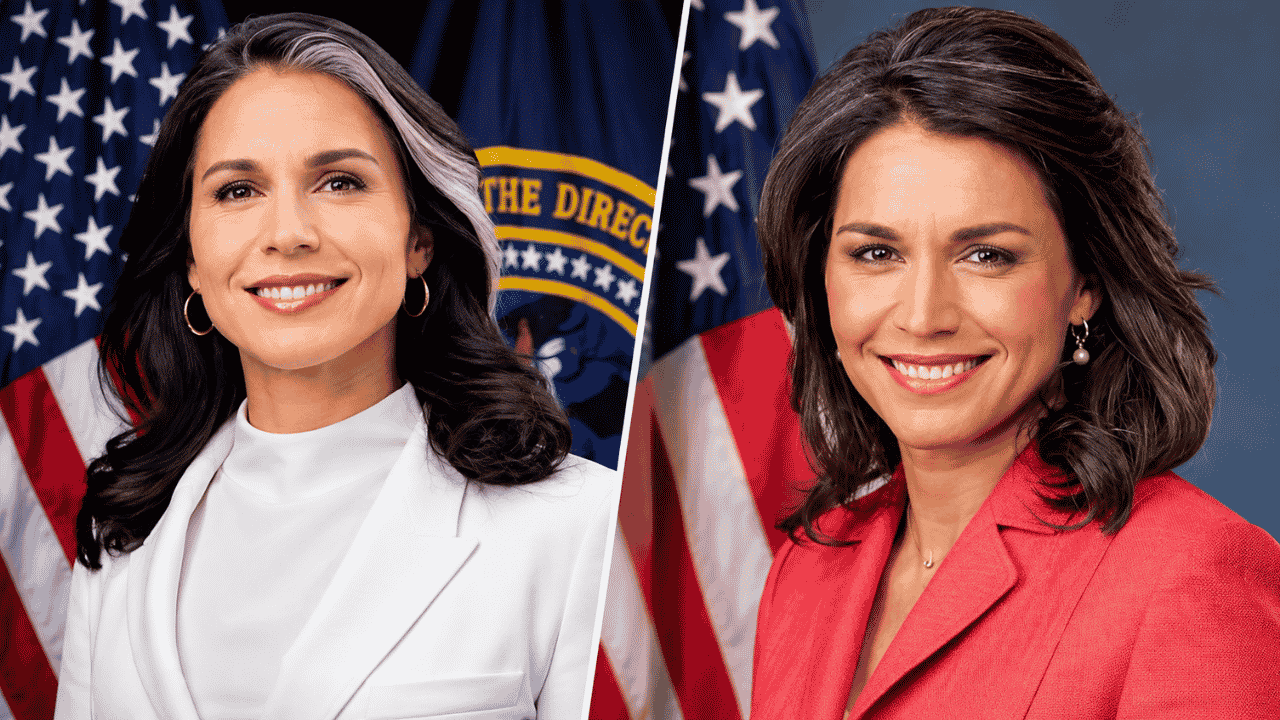
Tulsi Gabbard is an American politician, military veteran, former member of Congress, and former Director of National Intelligence whose career has taken several unusual turns. Born in American Samoa and raised in Hawaii, she entered public life at a remarkably young age and became the youngest woman elected to the Hawaii State Legislature at the time. Her military service later became a defining part of her public identity, including deployments to the Middle East while she was serving in the Hawaii Army National Guard. She went on to serve four terms in the U.S. House of Representatives, run for president in 2020, leave the Democratic Party, become a Republican, and serve in the Trump administration. The story of Tulsi Gabbard also includes her marriages, her relationship with Abraham Williams, her first marriage to Eduardo Tamayo, her public image, and continuing interest in questions such as Tulsi Gabbard net worth and Tulsi Gabbard hair.
Early Life and Family Background
Tulsi Gabbard was born on April 12, 1981, in Leloaloa, American Samoa. Her family later moved to Hawaii, where she grew up and developed many of the interests that would remain part of her identity, including surfing, public service, and military involvement. Her father, Mike Gabbard, became a prominent Hawaii politician, while her mother, Carol Porter Gabbard, was involved in education and community affairs. Growing up in Hawaii gave Gabbard a strong connection to the islands, and that connection remained central throughout her political career.
Her childhood was shaped by a family that was active in public and community life. She became involved in environmental activism while still young and helped establish the Healthy Hawai‘i Coalition as a teenager. The organization focused on environmental issues and opposed the use of harmful chemicals in Hawaii. That early experience gave Gabbard an introduction to political organizing long before she held elected office.
Religion and culture have also played an important role in her public identity. Gabbard is a practicing Hindu and has spoken publicly about the influence of Hindu philosophy on her life. Her first name, Tulsi, comes from the Sanskrit word associated with holy basil, a plant with religious significance in Hindu traditions. She became the first practicing Hindu elected to the U.S. Congress and one of the most recognizable Hindu politicians in American public life.
Education and the Beginning of Her Public Career
Gabbard’s educational path was not completely traditional. She attended Leeward Community College and later studied at Montana State University-Billings before completing her degree at Hawaii Pacific University. She earned a Bachelor of Science in Business Administration in 2009, with international business as her field of study. Her education was completed alongside an increasingly demanding political and military career, rather than before she entered public service.
Her political career began unusually early. In 2002, at only 21 years old, she won election to the Hawaii House of Representatives. At the time, she became the youngest woman ever elected to a state legislature in the United States, a distinction that helped establish her as a rising political figure. Her first term also demonstrated that she was willing to take positions on issues that mattered to her even when they created political difficulties.
Her time in the Hawaii legislature was interrupted by military service. After the September 11 attacks, Gabbard joined the Hawaii Army National Guard in 2003 and later deployed overseas. She eventually returned to politics and continued building a career that combined elected office with military service.
Tulsi Gabbard’s Military Service
Military service became one of the strongest threads running through Gabbard’s biography. She joined the Hawaii Army National Guard in 2003 and served for many years while also pursuing political work. Her service included deployments to the Middle East, including Iraq, and exposed her directly to the realities of military operations and foreign policy. She later continued her military career through the U.S. Army Reserve.
Her military experience strongly influenced the way she approached international affairs. Gabbard became known for criticizing what she viewed as unnecessary wars and military interventions, particularly policies involving regime change. During her congressional career, her position on foreign policy often differed from mainstream Democratic thinking, which helped distinguish her from many other members of Congress.
Her military record also contributed to her historic presidential campaign. When she sought the Democratic nomination in 2020, she became the first female combat veteran to run for president. Her background gave her credibility with voters interested in national security, veterans’ issues, and a less interventionist foreign policy.
Some notable parts of her military background include:
- Service in the Hawaii Army National Guard beginning in 2003
- Deployment to Iraq during Operation Iraqi Freedom
- Later service in the U.S. Army Reserve
- Advancement to the rank of lieutenant colonel
- Extensive experience combining military service with elected office
- A political focus on veterans, foreign policy, and national security
The U.S. House historical record lists her Hawaii National Guard service from 2003 to 2020 and her subsequent Army Reserve service. It also records her later appointment as Director of National Intelligence from 2025 to 2026.
Work Before Entering Congress
After her first period in the Hawaii state legislature and military deployment, Gabbard continued developing her political experience. She worked for Senator Daniel Akaka of Hawaii, gaining experience in federal politics and learning more about the relationship between Hawaii and Washington. That experience became useful when she later moved into national elected office.
Gabbard was also elected to the Honolulu City Council, serving from 2010 to 2012. The position gave her experience with local government and issues affecting residents on a day-to-day basis. Her career therefore developed through several levels of government rather than beginning immediately in Washington.
By the time she ran for Congress, Gabbard had already accumulated experience as a state legislator, military officer, congressional staffer, and city council member. That combination made her political background unusual for a candidate who was still relatively young.
Tulsi Gabbard’s Career in Congress
In 2012, Gabbard won election to Hawaii’s 2nd Congressional District. She took office in January 2013 and served four consecutive terms in the U.S. House through January 2021. During those years, she became one of Hawaii’s most recognizable national politicians and developed a reputation for taking independent positions on foreign policy.
Her committee assignments reflected her interest in national security. She served on the House Foreign Affairs Committee, Homeland Security Committee, and Armed Services Committee, while also serving on the Financial Services Committee during her final term. Her time on Armed Services was particularly relevant because of her military background.
Gabbard’s congressional career was not limited to foreign policy. She worked on veterans’ issues, national security, domestic policy, and other legislation affecting Hawaii and the wider United States. Her combination of military experience and congressional service allowed her to speak about defense policy from both a legislative and personal perspective.
Her congressional career can be summarized through several major milestones:
- Elected to Congress in 2012
- Took office in January 2013
- Served four House terms
- Served on Armed Services and Foreign Affairs
- Became a prominent voice on military intervention
- Served as a Democratic National Committee vice chair
- Declined to seek reelection in 2020
- Ran for the Democratic presidential nomination in 2020
The House historical record confirms that she served in the 113th through 116th Congresses and was not a candidate for reelection in 2020 because she pursued the presidency instead.
The 2020 Presidential Campaign
Gabbard announced her campaign for the 2020 Democratic presidential nomination in January 2019. Her campaign was built around several themes, particularly ending what she regarded as unnecessary military interventions and changing America’s approach to foreign policy. Her status as a military veteran gave her campaign a distinctive identity in a crowded Democratic field.
She participated in Democratic presidential debates and attracted significant attention, both from supporters and critics. Her foreign-policy positions generated intense discussion because they differed from those of many Democratic candidates. She also faced criticism over her views on international conflicts and her political history.
The campaign ended in March 2020 when Gabbard suspended her presidential bid. She later endorsed Joe Biden for president, although her political relationship with the Democratic Party would change considerably over the following two years.
The 2020 campaign became an important turning point because it gave Gabbard a national platform beyond Hawaii and Congress. It also introduced her to a much larger audience interested in her views on war, national security, civil liberties, and American foreign policy.
Why Tulsi Gabbard Left the Democratic Party
Gabbard’s relationship with the Democratic Party changed after her presidential campaign. In 2022, she announced that she was leaving the Democratic Party and becoming an independent. She argued that the party had moved away from values she believed were important, including free speech and a more restrained approach to government power.
Her decision received considerable attention because she had once been a Democratic congressional leader and presidential candidate. Leaving the party therefore represented a major political shift rather than a minor change in affiliation.
As an independent, Gabbard continued appearing in national political media and speaking about American politics. She increasingly criticized Democratic leaders and policies while becoming more aligned with conservative political figures.
Her political evolution eventually led to another major change.
Tulsi Gabbard and the Republican Party
In 2024, Gabbard joined the Republican Party and became an increasingly visible supporter of Donald Trump. Her political transition was notable because she had previously been a Democratic presidential candidate and had served as a vice chair of the Democratic National Committee.
Her move toward the Republican Party was driven by a number of political disagreements and changing views. National security, free speech, government power, and foreign policy remained central themes in her public statements.
The shift also brought Gabbard into Trump’s political orbit. She became part of his broader political network and was later selected for one of the most important national security positions in the federal government.
Director of National Intelligence
In November 2024, Donald Trump selected Gabbard as his nominee for Director of National Intelligence. The nomination attracted considerable attention because Gabbard had extensive military and political experience but did not have the conventional intelligence-agency career associated with many previous people considered for the position.
Her confirmation process included a Senate intelligence hearing in January 2025. The hearing focused heavily on her views about foreign policy, Russia, Syria, Ukraine, intelligence agencies, and the role of the intelligence community. She ultimately received Senate confirmation and became Director of National Intelligence in February 2025.
The DNI position placed her at the center of America’s intelligence system. The director coordinates the work of the U.S. intelligence community and serves as a key national security adviser to the president.
Her tenure was controversial at times. Critics questioned her approach to intelligence and some of her policy decisions, while supporters argued that her outsider perspective could challenge established practices inside the intelligence community.
Why Tulsi Gabbard Left the DNI Position
Gabbard’s time as Director of National Intelligence ended in 2026. The U.S. House historical record now lists her DNI service as running from 2025 to 2026, rather than describing her as the current intelligence director.
Her resignation was announced in May 2026 and became effective June 30. Public reporting connected her departure to her desire to spend more time supporting her husband, Abraham Williams, following his diagnosis with a rare form of bone cancer. At the same time, Reuters reported that a source familiar with the situation said the White House had forced her resignation, creating competing accounts of the circumstances surrounding her departure.
Donald Trump announced that Aaron Lukas, who had been Gabbard’s deputy, would serve as acting director after her departure. Trump publicly praised Gabbard’s performance and also connected her departure to her husband’s illness.
The end of her DNI tenure marked another major transition in a career already defined by changes in political direction. Rather than remaining inside the intelligence community, Gabbard moved back into a more public political and media role.
Who Is Tulsi Gabbard’s Husband?
Tulsi Gabbard’s Husband is Abraham Williams. Gabbard married Williams in 2015 in Hawaii, several years after her divorce from her first husband, Eduardo Tamayo. Williams has worked in the film and media industry as a cinematographer and filmmaker. His professional work has included camera operation and cinematography, giving him a career that is separate from Gabbard’s political activities.
Their relationship has remained comparatively private despite Gabbard’s highly public career. Williams has occasionally appeared alongside her at public events, but he has not pursued the same political profile.Gabbard’s marriage to Williams is distinct from her earlier marriage to Eduardo Tamayo. Keeping those two relationships separate is important because many biography pages about Gabbard mention both marriages together, which can sometimes cause confusion.
Tulsi Gabbard and Eduardo Tamayo
Before marrying Abraham Williams, Gabbard was married to Eduardo Tamayo. The two had known each other from a young age in Hawaii and were described as childhood sweethearts. They married in 2002, when Gabbard was still very young, and their marriage ended in divorce in 2006.
Military service played a significant role in the difficulties surrounding that period of her life. Gabbard was serving in the Hawaii Army National Guard and deployed to Iraq in 2004, placing considerable pressure on the young marriage.
Gabbard later spoke about the end of the relationship and explained that she eventually accepted that reconciliation would not happen. She subsequently stopped using the Tamayo surname and returned to using Gabbard professionally.
Eduardo Tamayo has largely remained outside public life since the divorce. Unlike Gabbard, he has not built a major public political career, and reliable information about his current professional and personal life remains limited.
Tulsi Gabbard Net Worth and Financial Background
Tulsi Gabbard net worth is one of the search topics that attracts significant online attention, but it needs to be approached carefully. Celebrity and political websites often publish a single estimated figure, yet those numbers can differ dramatically because they are based on incomplete public information or calculations from financial disclosures.
A financial disclosure is not the same thing as a net-worth statement. Government forms can show assets, liabilities, income sources, investments, and other financial interests within specified reporting categories, but the ranges reported on those forms do not necessarily establish an exact personal net worth.
For that reason, a precise number should not be presented as confirmed unless it comes directly from reliable financial records. Online claims about Gabbard’s wealth have varied widely, and readers should be cautious about articles that state a specific fortune without explaining how the figure was calculated.
Her career has included several sources of professional income, including:
- Congressional salary during her four House terms
- Military compensation from her service
- Income connected with media and public appearances
- Writing, speaking, and other professional activities
- Investments and other assets disclosed through required filings
The most responsible way to discuss Tulsi Gabbard net worth is therefore to distinguish verified financial disclosures from estimates published by third-party websites. A biography can mention that she has accumulated wealth through a long public career without inventing an exact figure.
Tulsi Gabbard Hair and Public Image
Tulsi Gabbard hair is another search topic that attracts attention because her appearance has remained recognizable throughout her political career. She has commonly worn her hair long and dark, with styles that have changed slightly depending on the occasion. During her years in Congress and her presidential campaign, her hairstyle became part of the visual identity associated with her public appearances.
Her appearance has also changed naturally across different stages of her career. Photographs from her early political years show a younger version of Gabbard, while later appearances during her congressional and federal service reflect changes in styling and presentation.
There is no need to attach unsupported claims to her hairstyle. Online searches sometimes lead to speculation about hair products, extensions, or cosmetic procedures, but those claims should not be treated as facts without reliable evidence.
The interest in Tulsi Gabbard hair is largely connected to her status as a recognizable public figure. Political audiences often become familiar with the appearance of prominent politicians because they see them repeatedly in television interviews, campaign events, congressional photographs, and public appearances.
Historic Achievements in Politics and Military Service
Gabbard’s career contains several milestones that distinguish her from most American politicians. She entered elected office at 21, served in the military while pursuing politics, became the first American Samoan woman elected to Congress, and became the first practicing Hindu member of Congress.
Her presidential campaign also gave her a place in American political history as the first female combat veteran to seek the presidency. Her later move from Democrat to independent and then Republican added another unusual chapter to her political biography.
Her major achievements include:
- Becoming the youngest woman elected to the Hawaii State Legislature at the time
- Serving in the Hawaii Army National Guard
- Deploying to Iraq
- Serving four terms in the U.S. House
- Becoming a prominent military veteran in national politics
- Running for president in 2020
- Becoming the first practicing Hindu member of Congress
- Serving as Director of National Intelligence
- Moving from the Democratic Party to independent status and later the Republican Party
These milestones help explain why Gabbard has remained a subject of public interest even after leaving elected congressional office.
Tulsi Gabbard’s Political Legacy
Gabbard’s political legacy is difficult to place within one traditional category. Her early career was strongly associated with the Democratic Party, but her foreign-policy views often placed her outside the party’s mainstream. Her later departure from the Democrats and move toward the Republican Party made her political identity even more unusual.
Foreign policy has remained the most consistent theme across her career. Her military background influenced her opposition to what she considered unnecessary wars, while her later political positions brought her closer to conservative voters who shared concerns about government power and national security.
Her career also demonstrates how quickly political identities can change. Gabbard went from Hawaii state legislator to Democratic congresswoman, presidential candidate, independent political figure, Republican, and senior intelligence official within a relatively short period.
Whether viewed positively or negatively, her career has generated substantial debate. Supporters point to her military service, willingness to challenge party leadership, and national security experience, while critics have questioned some of her foreign-policy positions and decisions while serving in federal government.
Where Is Tulsi Gabbard Now?
As of 2026, Gabbard is no longer serving as Director of National Intelligence. Her official congressional biography records her DNI tenure as 2025–2026, while reporting on her departure says her resignation became effective June 30, 2026.
Her departure represents another transition in a career that has repeatedly moved between military service, elected politics, media, and federal government. She remains a recognizable national political figure because of her four terms in Congress, presidential campaign, military background, and role in the Trump administration.
Her future political role is less certain than her past positions. She has already demonstrated a willingness to change political direction, so her next chapter may not follow the conventional path of a former federal official.
For readers searching for Tulsi Gabbard biography information, the key point is that her story cannot be reduced to one political office. Her career has involved military service, local politics, Congress, presidential politics, political realignment, and national intelligence leadership.
Conclusion
Tulsi Gabbard has built one of the more unusual political careers in recent American history. From her childhood in Hawaii and early environmental activism to becoming a state legislator at 21, her path into public service started much earlier than it does for most national politicians. Military deployments then shaped her views on war and foreign policy, while four terms in Congress gave her a national platform.
Her 2020 presidential campaign expanded her public profile beyond Hawaii, but her later departure from the Democratic Party changed the direction of her career. She became an independent, joined the Republican Party in 2024, and was selected by Donald Trump to serve as Director of National Intelligence in 2025. Her resignation from that position in 2026 added another major transition to a career already marked by political change.
Questions about Tulsi Gabbard husband, Tulsi Gabbard net worth, Tulsi Gabbard hair, military service, education, and political beliefs continue to attract search interest because her public life combines politics, military service, personal history, and national security. Her marriages to Eduardo Tamayo and Abraham Williams are separate chapters of her personal life, while her military and political careers form the central story of her public biography. Whatever direction she takes next, Gabbard’s career has already established her as a distinctive figure in American politics.
Frequently Asked Questions
Who is Tulsi Gabbard?
Tulsi Gabbard is an American politician and military veteran who served four terms in the U.S. House of Representatives. She later became a Republican after previously serving as a Democrat and independent, and she served as Director of National Intelligence from 2025 to 2026.
Who is Tulsi Gabbard’s husband?
Tulsi Gabbard’s husband is Abraham Williams. They married in Hawaii in 2015. Williams works in the film industry as a cinematographer and filmmaker, and he has generally maintained a lower public profile than his wife.
Who was Tulsi Gabbard’s first husband?
Tulsi Gabbard’s first husband was Eduardo Tamayo. They married in 2002 after knowing each other from childhood and divorced in 2006. Gabbard later married Abraham Williams in 2015.
What is Tulsi Gabbard’s net worth?
There is no single officially confirmed public figure that should automatically be treated as Tulsi Gabbard’s exact net worth. Online estimates vary, and financial disclosure ranges should not be confused with a confirmed net-worth figure. Any reliable discussion should distinguish documented financial information from third-party estimates.
Why did Tulsi Gabbard leave the DNI position?
Gabbard resigned as Director of National Intelligence in 2026, with her departure effective June 30. Public reporting linked the decision to her husband’s illness, while other reporting cited a source who said the White House had forced her resignation. The circumstances therefore should be described carefully rather than as an uncontested single explanation.