









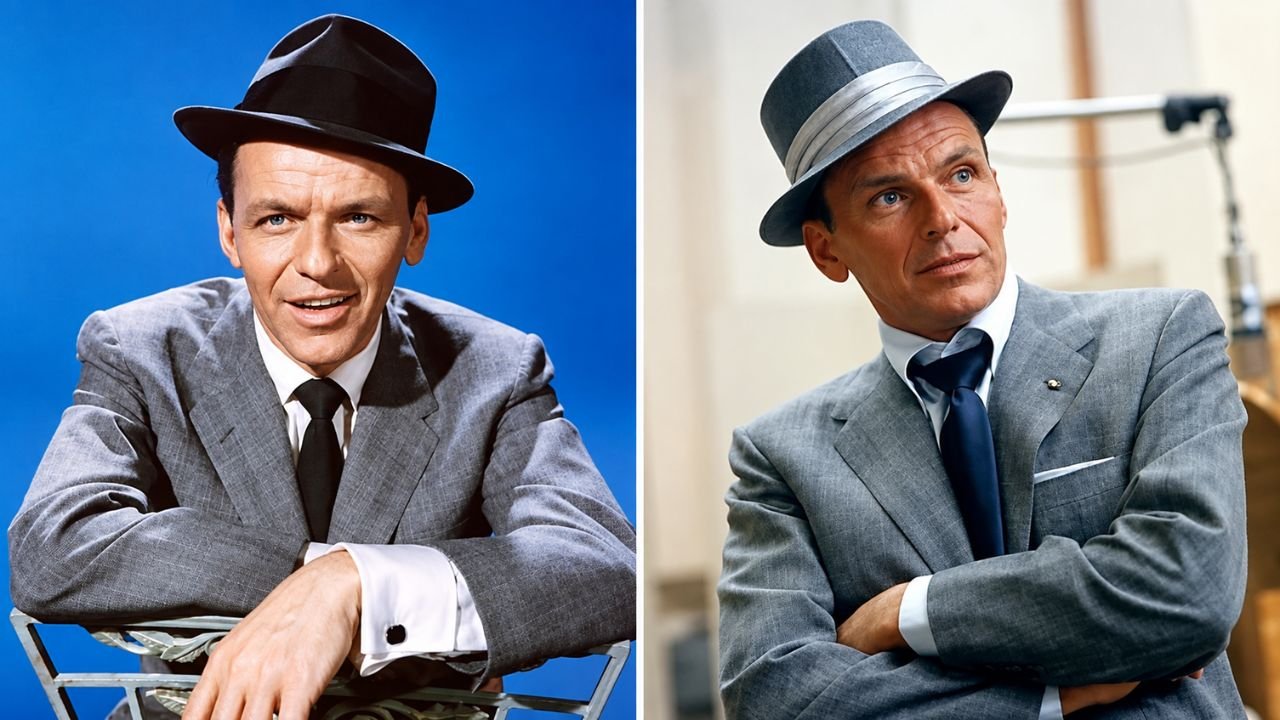
Frank Sinatra was one of the most influential entertainers of the 20th century, known for a singing style that changed popular music and an acting career that earned him major recognition in Hollywood. Born in Hoboken, New Jersey, in 1915, he moved from local performances to national fame with the Tommy Dorsey Orchestra before building a successful solo career. His voice, phrasing, and ability to bring emotion to a lyric helped make him a defining figure of American popular music. Beyond singing, he worked as an actor, producer, businessman, and record-label founder, creating a career that lasted for more than five decades.
Early Life and First Break
Frank Sinatra was born on December 12, 1915, to Italian immigrant parents in Hoboken, New Jersey. Music interested him from an early age, and he was especially influenced by the recordings of Bing Crosby, whose relaxed vocal approach showed him that a singer could make a strong impression without relying only on volume. Sinatra left high school without graduating and began looking for opportunities to perform professionally. His first important national exposure came in 1935 when he appeared on the radio program Major Bowes’ Original Amateur Hour as part of a singing group.
The group, initially known as the Three Flashes and later as the Hoboken Four, won the competition and toured as part of the show’s entertainment circuit. The experience gave Sinatra practical knowledge of performing before audiences and helped him understand the demands of professional entertainment. Although the group did not become a major long-term success, the exposure gave Sinatra a starting point. He continued performing in New Jersey and New York while looking for a larger opportunity.
Harry James, Tommy Dorsey and the Rise to Fame
A major turning point came in 1939 when trumpeter and bandleader Harry James offered Sinatra a position with his orchestra. Sinatra recorded with James and gained valuable experience as a professional vocalist, but his career changed even more dramatically when he joined Tommy Dorsey’s orchestra in 1940. Dorsey’s band was one of the leading orchestras of the era, giving Sinatra access to a much larger national audience.
Working with Tommy Dorsey had a lasting effect on Sinatra’s singing technique. Dorsey was famous for his smooth trombone playing, and Sinatra studied the way the instrument controlled breath and phrasing. Sinatra began developing a vocal style built around precise timing, controlled breathing, and emotional interpretation rather than simply singing loudly. His work with the orchestra produced popular recordings and established him as one of the most promising young singers in the country.
By the early 1940s, Sinatra had developed a large following among young listeners, particularly teenage girls who became known as “bobby-soxers.” His popularity was unusual for a male singer at the time and helped demonstrate the growing commercial power of young audiences. In 1942, Sinatra left Dorsey’s orchestra to pursue a solo career, a decision that eventually transformed him into a major entertainment star.
The Career Crisis That Nearly Ended His Rise
Sinatra’s early solo success was enormous, but his career did not continue smoothly. By the late 1940s and early 1950s, his popularity declined as musical tastes changed and personal difficulties affected his professional life. His voice also suffered problems, including a vocal-cord hemorrhage that temporarily affected his ability to perform. For an entertainer who depended almost entirely on his voice, the setback was serious.
Instead of disappearing from the entertainment industry, Sinatra rebuilt his career in a different direction. His breakthrough came with the 1953 film From Here to Eternity, in which he played Private Angelo Maggio. The performance earned him the Academy Award for Best Supporting Actor and helped change the public perception of him from a fading singer into a serious actor. The Oscar became one of the most important turning points in his career.
Capitol Records and a New Musical Identity
After his comeback, Sinatra signed with Capitol Records and entered one of the most artistically important periods of his career. He worked with arrangers including Nelson Riddle, Gordon Jenkins, and Billy May, developing albums that were carefully structured around themes, moods, and musical arrangements. Instead of treating an album as simply a collection of unrelated singles, Sinatra helped establish the idea of the concept album in popular music.
Several important recordings came from this period, including In the Wee Small Hours, Songs for Swingin’ Lovers!, Come Fly with Me, Only the Lonely, Come Dance with Me!, and Nice ‘n’ Easy. Each project presented a different side of his musical personality, ranging from romantic ballads to energetic swing performances. His interpretations became known for making lyrics sound conversational and personal, as though he were speaking directly to the listener.
Some of the most recognized frank sinatra songs from his career include:
- “My Way”
- “Fly Me to the Moon”
- “I’ve Got You Under My Skin”
- “Come Fly with Me”
- “New York, New York”
- “The Way You Look Tonight”
- “Night and Day”
- “My Funny Valentine”
- “Strangers in the Night”
- “That’s Life”
Songwriters were also central to Sinatra’s success. Sammy Cahn and Jimmy Van Heusen became particularly important collaborators, creating songs that suited his vocal personality. Their work helped produce recordings such as “All the Way” and “High Hopes,” both of which became closely associated with Sinatra.
Reprise Records and Greater Artistic Control
In 1960, Sinatra founded Reprise Records because he wanted greater control over his music and career. At a major record company, artistic decisions could be influenced by executives, contracts, and commercial expectations. Creating his own label gave Sinatra more freedom to choose projects, musicians, recording styles, and release strategies.
Reprise also reflected the business side of Sinatra’s personality. He was not only a performer but also someone who understood the importance of controlling the way his work reached audiences. The label later became part of Warner Bros., but its creation remains an important part of Sinatra’s career because it demonstrated how performers could seek greater independence from traditional recording companies.
Frank Sinatra Songs and His Distinctive Style
The lasting appeal of frank sinatra songs comes from more than melody or orchestration. Sinatra had an unusual ability to change the emotional meaning of a lyric through timing, pauses, emphasis, and subtle changes in volume. He rarely sounded as though he were simply reciting words from a page. Instead, he treated songs as stories and used his voice to communicate the character and emotion behind them.
His recordings covered many different moods. Romantic ballads allowed him to emphasize vulnerability and loneliness, while swing arrangements showed his ability to create energy and confidence. Songs such as “I’ve Got You Under My Skin” demonstrated his command of rhythm, while “My Way” became closely connected with his public image and later generations of listeners.
His major musical strengths included:
- Careful phrasing and timing
- Strong interpretation of lyrics
- Ability to work with large orchestras
- Distinctive conversational delivery
- Strong control of dynamics and pauses
- Willingness to experiment with album themes and arrangements
This combination helped Sinatra influence generations of singers. His importance was not simply based on the number of records he sold, but also on how he changed the expectations surrounding popular vocal performance.
Frank Sinatra Movies and Hollywood Career
Acting became a major part of Sinatra’s career after his successful performance in From Here to Eternity. His filmography included dramas, musicals, comedies, and crime films, allowing him to demonstrate a range that was not always obvious from his singing career.
Among the best-known frank sinatra movies are The Man with the Golden Arm, Guys and Dolls, Pal Joey, The Manchurian Candidate, and Ocean’s Eleven. The Man with the Golden Arm gave Sinatra another demanding dramatic role, while Guys and Dolls and Pal Joey allowed him to combine acting with his musical talents.
Sinatra was also known for his efficient approach to acting. He developed a reputation for being able to deliver scenes quickly and effectively, earning the nickname “One-Take Charlie.” His screen performances did not rely solely on his celebrity status; at his best, he used restraint and timing in much the same way he approached a song.
Frank Sinatra and the Rat Pack
During the 1950s and 1960s, Sinatra became closely associated with a group of entertainers that included Dean Martin, Sammy Davis Jr., Peter Lawford, and Joey Bishop. The group became popularly known as the Rat Pack and became strongly associated with Las Vegas entertainment.
Their performances combined music, comedy, improvisation, and celebrity appeal. Sinatra’s position within the group gave him another platform for entertainment outside traditional concerts and films. The Rat Pack image also became connected with Ocean’s Eleven, the 1960 film featuring Sinatra, Martin, Davis, Lawford, and others.
The group’s cultural influence extended beyond the stage. Their performances helped establish Las Vegas as an important destination for major entertainment acts and created an image of sophistication, nightlife, friendship, and show-business confidence that remained associated with Sinatra for decades.
Family, Marriages and Frank Sinatra Jr.
Sinatra’s personal life attracted significant public attention throughout his career. He was married four times, first to Nancy Barbato, followed by actress Ava Gardner, actress Mia Farrow, and finally Barbara Marx. His family included three children: Nancy Sinatra, Frank Sinatra Jr., and Tina Sinatra.
Frank Sinatra Jr. followed his father into the entertainment industry and became a singer, songwriter, conductor, and arranger. His career was inevitably compared with his father’s, but he developed his own work within the music business. The relationship between father and son was sometimes complicated by the enormous expectations surrounding the Sinatra name.
One of the most serious incidents in the family occurred in 1963, when Frank Sinatra Jr. was kidnapped. He was later released after his kidnappers demanded a ransom. The incident received widespread media attention and became one of the most dramatic episodes connected to the Sinatra family.
Politics, Civil Rights and Public Life
Sinatra was also involved in American public life. He supported John F. Kennedy during the 1960 presidential campaign and performed at events connected with Kennedy’s inauguration. Their relationship later became strained, illustrating how Sinatra’s political connections could change over time.
His public activities were not limited to politics. Sinatra also spoke against racial prejudice and supported efforts promoting greater equality. His 1945 short film The House I Live In addressed antisemitism and racial discrimination and reflected his opposition to prejudice during a period when such issues were often treated differently by mainstream entertainment.
His public image therefore contained several sides. He could be associated with glamorous nightlife and celebrity culture while also participating in charitable, political, and social causes. These different aspects made Sinatra a complicated public figure whose influence extended beyond music and film.
Later Career, Duets and Final Performances
Sinatra remained active through several changes in the music industry. Although he periodically suggested retirement, he repeatedly returned to recording and performing. His later career included successful projects designed to introduce his music to new audiences while maintaining the style that had defined him.
The Duets album, released in 1993, paired Sinatra with other major performers, while Duets II followed in 1994. These recordings included collaborations with artists such as Barbra Streisand, Bono, Tony Bennett, and Aretha Franklin. The projects demonstrated the continuing commercial and cultural interest in Sinatra even decades after his first major successes.
By the mid-1990s, Sinatra’s public performances became increasingly limited. His final years were marked by health problems and a gradual withdrawal from professional life. He died on May 14, 1998, in Los Angeles at the age of 82.
Awards and Major Honors
Sinatra’s career brought recognition from both the entertainment industry and the American government. His awards reflected achievements in music, acting, and his wider contribution to American culture.
Some of his most significant honors included:
- Academy Award for Best Supporting Actor for From Here to Eternity
- Multiple Grammy Awards and Grammy-related honors
- Kennedy Center Honors in 1983
- Presidential Medal of Freedom in 1985
- Congressional Gold Medal in 1997
- Recognition for his contributions to American music and entertainment
These honors illustrate the unusual breadth of his career. Sinatra was successful in recording studios, on concert stages, in Hollywood, and within the broader entertainment business.
Frank Sinatra’s Lasting Legacy
Frank Sinatra’s legacy rests on the way he combined music, acting, business, and personality into one career. He helped popularize the album as an artistic format, influenced generations of vocalists, and showed that a singer could move successfully between recording studios, concert halls, television, and Hollywood. His work with arrangers and songwriters also helped establish a sophisticated standard for popular vocal music.
His influence can still be heard in singers who focus on phrasing, storytelling, timing, and emotional interpretation rather than relying only on vocal power. His recordings continue to be revisited because the performances often feel personal rather than tied to a particular era. The most successful frank sinatra songs have remained recognizable across generations because their themes of love, regret, ambition, loneliness, and resilience are universal.
Sinatra’s career also demonstrated the value of reinvention. He moved from teenage idol to struggling performer, from singer to Oscar-winning actor, and from traditional recording-company artist to record-label founder. Few entertainers managed to remain relevant across so many changes in popular culture.
Frequently Asked Questions
Who was Frank Sinatra?
Frank Sinatra was an American singer, actor, producer, and businessman who became one of the most influential entertainers of the 20th century. He was famous for his distinctive vocal phrasing, major recordings, Hollywood performances, and work with the Rat Pack.
What are some of the most famous Frank Sinatra songs?
Some of his best-known songs include “My Way,” “Fly Me to the Moon,” “New York, New York,” “I’ve Got You Under My Skin,” “Come Fly with Me,” “Strangers in the Night,” and “The Way You Look Tonight.”
What was Frank Sinatra’s most important movie?
From Here to Eternity was one of the most important films of Sinatra’s career because his performance as Private Angelo Maggio earned him the Academy Award for Best Supporting Actor. The success helped revive his career at a crucial point.
Who was Frank Sinatra Jr.?
Frank Sinatra Jr. was Sinatra’s son and a professional musician who worked as a singer, songwriter, conductor, and arranger. He pursued his own career while dealing with the enormous expectations created by his father’s fame.
Was Frank Sinatra part of the Rat Pack?
Yes. Sinatra became the central figure of the Rat Pack entertainment group associated with Dean Martin, Sammy Davis Jr., Peter Lawford, and Joey Bishop. Their performances and films became an important part of American popular culture during the 1950s and 1960s.
Conclusion
Frank Sinatra’s career was much larger than a collection of famous songs and movies. He transformed himself several times, surviving career setbacks and adapting to changes in music, film, and popular culture. His work with major arrangers, songwriters, and musicians helped shape the sound of American popular music, while his film performances established him as a respected actor.
From his early days in New Jersey to his years with Tommy Dorsey, his Capitol Records recordings, Hollywood success, Rat Pack performances, and later collaborations, Sinatra built an unusually broad career. His influence remains visible in the way singers approach lyrics, phrasing, album-making, and stage performance. More than two decades after his death, frank sinatra remains a defining name in American entertainment history.
For more stories about famous personalities, explore our celebrity biographies.